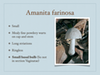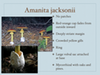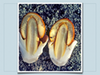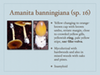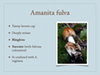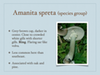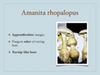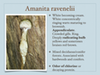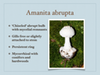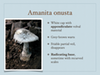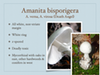
Click on the first slide to see an enlarged version and to progress through the presentation.

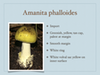
There are roughly 600 species of amanitas worldwide. Five percent of the world’s fatalities from mushrooms are in this group. 50 percent of these are from mushrooms in the Amanita phalloides group, which includes Amanita virosa (bisporigera), Amanita verna and allies. 001-001
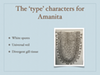
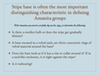
This presentation is focused on visible macro characteristics of amanitas. If you were amanita expert Rod Tulloss, you would combine your knowledge of the morphology of amanitas with chemical tests and microscopic analysis to definitively identify them. If you have a mushroom with white spore and free gills, it is either a Lepiota or an Amanita. This describes a combination of characters that exits for relatively few amanitas. It is sort of a composite of Amanita virosa and Amanita muscaria. 002-001
Divergent gill tissue can be seen using a microscope. Take a cross-section of the gills and look at it under a microscope and you will see that the cells stream outward from a central core as they grow downward. 003-001
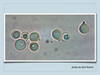
Sometimes the only way to be sure you are close to an identification is to see how the amanita reacts with Meltzer’s reagent. 008-001
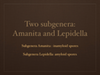
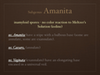
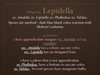
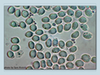
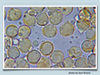
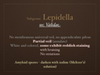
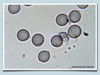
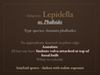
There are two subgenera and a total of seven groups with three sections in subgenera Amanita and 4 sections in subgenera Lepidella. When Meltzer’s regeant is applied to the spores of amanitas in the subgenera Amanita and there is no change in the spore walls, then the reaction is inamyloid. 009-001
There are 7 sections total: 3 in the subgenus Amanita and 4 in the subgenus Lepidella. The species in the three subgenus Amanita groups all have inamyloid spores. The species in the Lepidella subgenus all have amyloid spores. 010-001
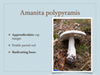
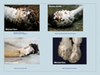
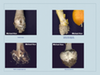
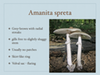
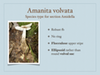
Amanita virosa may not be here. It was originally described from Switzerland as having a shaggy stalk and pointed cap in youth.The toxin is a protein by the name of alpha amanitin which works by slowly attacking an enzyme in the liver. Both the liver and the kidneys are ultimately affected about 6 to 24 hours after consumption. Symptoms include violent cramps and diarrhea. There is a false remission of symptoms by the third day. On the 4th and 5th day the liver and kidneys continue to break down. Death follows unless a liver transplant can be performed. The same toxin is in the Autumn galleria. 055-001