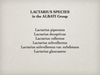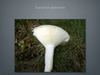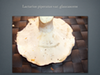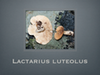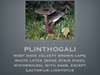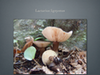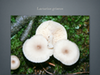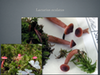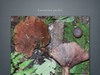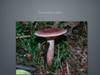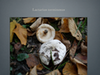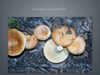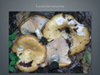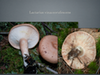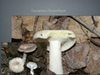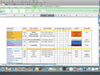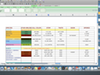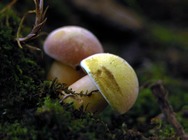
Click on the first slide to see an enlarged version and to progress through the presentation.
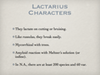
LACTARIUS is in the Russulaceae along with Russula species.Lactarius differs from other mushrooms in having a convex to vase-shaped cap on a ringless stipe. They lactate on cutting or bruising. Like russulas, they break easily. Mycorrhizal with trees. 001-001
Most common during summer and fall. It’s a large genus with over 400 species world-wide and 200 species from North America. Terrestrial and throughout world. 002-001
Spore print can be variations of white, cream yellow and ochre. Odor and taste peppery, mild, sweet color of latex, volume, does it change color or stain with exposure to air. 003-001
Lactarius quietus smells like bed bugs or wet laundry. Lactarius helvus (aquifluus) has a coconut odor. Others smell like maple syrup, curry, fenugreek or burnt sugar. The odors can become more concentrated when the mushroom dries. 006-001
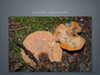
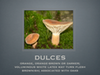
Looks like Lactarius deliciosus, but TURNS GREENER overall. Stipe has white ring-like mark at apex. There are NO CIRCULAR PITS on stem. Flesh turns darker red on exposure. Under spruce in mountainous regions. Taste PEPPERY. 009-001
No part of this mushroom in Europe turns green. Found in mixed woods. (Another European species). Here it may, assuming we are all talking about the same mushroom. 010-001
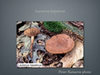
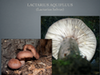
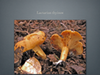
Lactarius thyinos. Bright orange-ringed fruitbody with orange latex, which is unchanging. (Only orange lactarius with orange milk that doesn't turn green). Stipe sticky at apex. Common in swampy areas under Northern White cedar. Edible.
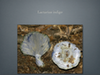
Zonate blue cap and stem with circular pits. Turns silvery with age. Latex bight blue turning greenish slowly. Cream spores. In oak/pine woods. Edible. 012-001
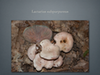
Zonate wine-purple to pinkish cap mottled with green. Wine-red gills and stipe. Stipe also with circular pits. Latex is scant, wine-red and somewhat peppery. Cream spores. Under pines. Edible. 013-001
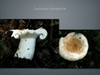
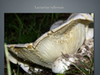
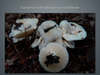
Cap large, crumbly, chalky, nearly smooth, velvety, depressed in the center, inrolled margin; Gills decurrent, thin, narrow, crowded. Latex white. Peppery taste. " "Off-white SP "Micorrhizal w both dec & conifer trees in well-drained soil." "Similar-looking Lactarius deceptivus has cottony inrolled margin and its latex does not change color." Mature cap funnel-shaped, dry and slightly velvety. Very crowded white to cream gills. White acrid latex. Under deciduous trees. Inedible. 016-001
Large white mushroom w inrolled, cottony margin, acrid taste. Cap convex bcmg sunken to vase-shaped. Dry, smooth, aging scaly, staining brownish w yellwsh areas. LATEX, WHITE, UNCHANGING, STAINS BROWN. Odor pungent. Gills close-distant,attached,cream stains darker. Stipe, too. White to pale ochre-buff. On ground under hemlock or oak. Look-a-likes: L. piperatus has extremely close gills. L. vellerus lacks cottony roll of tissue. Large white depressed cap with strongly inrolled, wooly margin. Crowded white gills, somewhat decurrent. Latex acrid, white. Stipe is white, short, velvety. Mixed woods. Inedible. 018-001
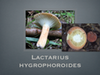
Larger than Lactarius piperatus, but with felty cap and more widely-spaced gills. FLESH ACRID, but LATEX MILD! Found in fall under deciduous trees. 019-001
Velvety white cap and stem, latex pale yellow-cream, gills whitish becoming yellowish and spotting pinkish-brownish. White spore print. Deciduous woods. Gills not tightly together like L. piperatus. No brown spots on cap like L. deceptivus. 020-001
Gills cream-colored, close, white latex & flesh bruising brown. Latex flows voluminously. Odor FISHY. 023-001
Dry, wrinkled, bright orange-fawn. Cream-colored, widely-spaced gills. Abundant mild, white latex. Taste is mild. White spores. Under deciduous trees. 024-001
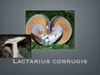
Reddish-brown wrinkled-corrugated cap. Ochre gills. Copious white latex, mild to taste. Fish-like odor when old. Under deciduous trees. Edible. 025-001
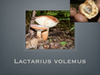
Dry, velvety, pale buff, small cap - flesh white, latex voluminous and sticky STAINING all parts BROWN. Fishy odor. In deciduous and mixed woods with oak. Edible. Closely related to Lactarius volumes. 026-001
Brown margined gills. White latex doesn't stain pinkish-reddish like Lactarius lignyotus (without brown margin) or Lactarius lignyotus var, canadensis (with brown margin and pink staining). 030-001
Dry, velvety, wrinkled brownish cap. Latex white and unchanging. Gills well-spaced. Deciduous and coniferous woods. Edible. 032-001
In MOSSY BOGS, humus, with CONIFERS. Small, Dry cap with gray hairy scales in center - darker than margin. White ring at stipe apex? Stem fragile and hollow. Latex scanty and white drying yellowish on gills (no staining). Inedible. 035-001
Reddish-brown cap with prominent umbo, paler toward margin. Scanty watery to whey-like latex. 036-001
Matte and liver-colored, occassionaly umbonate, with lightly furrowed margin. Ochre-pink gills slightly decurrent. Abundant latex slightly yellowish. Acrid to bitter taste. 037-001
Smell: SWEET, becoming COCONUT as it dries. Dry cap, pinkish brown to pinkish grey. Latex white becoming watery with maturity. Taste hot, acrid, drying YELLOWISH on tissue (May take an hour or two). Gills pinkish buff to cream. 038-001
Unzoned; Mature cap chestnut-reddish with small umbo in depression center. Downy margin in young specimens. Crowded, sw decurrent gills, cream bcmg reddish. Stipe paler concolorous, but white at base. White flesh. Latex abundant, quickly ACRID taste. In CONIFEROUS woods. 040-001
Pale pinkish-orange cap center, somewhat zonate & depressed, wooly margin inrolled. Firm flesh. Creamy pink gills. Stipe concolorous, somewhat pitted. Latex white & acrid. Under birch. Poisonous. 043-001
Orange, strongly ZONED cap, thick flesh, acid white latex that slowly stains flesh PINKISH-CINNAMON. DECURRENT cream to pinkish buff gills, close, PITTED STIPE. In deciduous woods with oak and hickory. 044-001
Zonate orange cap. Acrid white latex drying gray on decurrent, narrow, close gill edges. White gills maturing to cream-yellow and then bright ochre-yellow. Stain tawny-brown on bruising. Stalk not scrobiculate. Under deciduous trees, esp. oak. 045-001
Flesh and latex are white but change to bright YELLOW on cutting. Develops dull vinaceous-brown stains over most of mushroom. Not a good edible. 046-001
Cream to pale yellow to orange cap, sw ZONED with Watery spotscream gills. White flesh & gills. Slowly acrid white latex turns bright SULPHUR YELLOW on contact w air." Pale yellow spores. Under oaks. Similar to L. vinaceorufescens. Not a good edible. 047-001
Yellow-brown margin, darker olive brown cap center.White flesh stains brown slowly when bruised. Flesh and latex acrid. White latex stains crowded whiste to yellowish gills brown. Hollow staked is pitted. In conifer woos. KOH reaction on cuticle of cap is magenta. 048-001
Zonate purplish cap that bcms darker with age. White latex stains flesh and gills purple. Mild to slightly bitter taste. Associated with birch and pines. Cap surface turns green when KOH is applied. 049-001