Click on the first slide to see an enlarged version and to progress through the presentation.
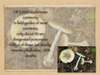
Terms: Sabropic, Parasitic and Mycorrhizal. Common Names vs Scientific Names. Labels and what they mean: Edible, Poisonous or Toxic (or Deadly), and Not Recommended. The last category is the most variable, because a mushroom that is not considered palatable in one culture may be enjoyed in another for its taste and/or texture or culturally accepted medicinal benefits. Another point to keep in mind is that even with highly prized choice edibles, like chanterelles or Grifola frondosa, individuals may not be able to tolerate them. There are also some people who can eat the mushrooms on their won, but have a reaction when consuming them with alcohol. This is not a comprehensive survey of all the edible and all the poisonous mushrooms you may encounter, but rather a introductory sampling of some of the more common edible fungi and their toxic look-a-likes. It is important to keep a proper perspective on the subject of toxic fungi. Only about 50 of the roughly 2000 that are most frequently included in field guides are listed as poisonous. Of these, far fewer still are considered fatally toxic. Rather than spend too much time worrying about whether or not the mushrooms you see are poisonous or edible, learn to identify the 50 or so toxic mushrooms and the 100-200 that are considered choice or at least worth eating. Then expand your interests to the majority of mushrooms which deserve to be appreciated for things other than there edibility: such as the role they play in their habitat. 001-001
The FB stays put (like a plant), but it is the ‘fruit’ of the fungus. The fungus itself, which is made up of mycelium (pl) (mycelia - singular) moves outward in search of nutrients until blocked physically (or chemically). Chitan (a polysaccharide) is the same material that the exoskeleton of arthropods (insects, spiders, crustaceans) is made of. 006-001
Fungal species outnumber plants species by 6 to 1. This diversity is required for the many roles and niches fungi have in the health of the planet. 007-001
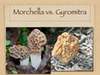
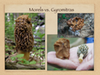
Ascomycetes. Both come out about same time in spring and often appear in same area. Several species of morels still to be sorted out: M. elata (European) (5 spp) & first to appear), M. semilibera, M. esculenta Morels are pitted and have hollow stipes. The cap is fused to the stipe. Gyromitra esculenta (Eur.), gigas (Eur.) or brunnea. Unlike morels, they are not completely hollow. They may exhibit a cotton mycelium and more stipe material. They have reddish brown, yellow, brown or brown lobed caps. Morels are found in apple orchards, and under ash and tulip poplar trees. Both morels and gyromitras may be both saprobic and mycorrhizal at various times in their life cycle. Cooking tip: Dry morels for future use. Rehydrate and cook them in cream. In Europe G. esculenta is considered edible. Yet 2 to 4% of fatalities are associated with eating them. They contain gyromitrin, which metabolizes to rocket fuel in the body. (Monomethylhydrazine) that destroys red blood cells. Period between ingestion and symptoms of vomiting, diarrhea, weakness, and headache is between 6-12 hours. Treatment is with Vit. B6. In the worst cases, patients become jaundiced, suffer convulsions, coma and death. Poisonous raw. Parboiling (2x) evaporates the active ingredient. But inhalation of fumes can be lethal. In the U.S. gyromitras may have variable amounts of gyromitrin. In the east seem to have more gyromitrin than those in the west, where they are eaten by some. It is recommended that we not eat them as in any case they are carcinogenic to at least mice. Morels and lead/arsenic poisoning from morels collected at apple orchards .013-001
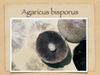
Agaricus bisporus—known variously as the common mushroom, button mushroom, white mushroom, table mushroom, cremini, crimini mushroom, Swiss brown mushrooms, ...Photo by Sam Ristich. 015-001
Stropharias, or winecaps, grow gregariously on wood chips and are a tasty edible (potatoes), when in the early button stage. Fresh specimens have a burgundy cap (that fades in the sun and with age), a ‘cog-wheel’ ring and white rhizomorphs at the base of the mushroom. It has a purple-black spore-print. David Aurora has speculated that this may be an alien species, a weed. In any case, it has become ubiquitous with the increased use of wood chips to suppress the growth of weeds. After the morel, it is among the first edible species to become visible in spring (and fall) urban and suburban gardens. 016-001
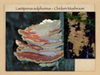
infected trees. It is a saprobe and may also be s.w. parasitic as it can be found on living as well as fallen trees. They are best when fresh and young and when the leaves are soft. L. cincinnatus, being thinner and softer in texture, is often the preferred variety for culinary purposes. Either polypore is an excellent vegetarian substitute for chicken. 017-001
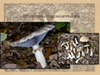
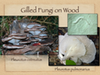
Oyster mushrooms are saprobes on decaying wood. Their diet also consists of nematodes and bacteria in the wood which they kill with a toxin and then inhabit by hypha entering the mouth and digesting the nematode from the inside out. 018-001
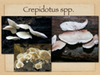
On the east coast of the US we have Crepidotus applanatus, Crepdotus chrocophylus and Crepidotus malachius. 019-001
Has been confused with Pleurotus ostreatus. While not toxic, It is very bitter and hot on the tongue. Like the oyster, it is in the Tricholomataceae, but its gills are serrated and the top of its cap is ‘hairy.’ 020-001
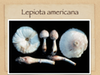
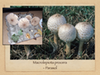
(Lepiota, Macrolepiota) The Shaggy Parasol. Known for its red-staining flesh, scaly cap, white free gills, movable ring, bulbous base, and nutty flavor. Another similar popular edible is Lepiota americana, which bruises yellow. Some people experience gastrointestinal pain and diarrhea when eating one or both of these mushrooms, so it is recommended that when you try them for the first time, just eat a small portion to taste and see who you react. The same caution can be suggestion for eating anything from nuts to grains or vegetables! 022-001
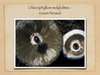
The Shaggy Parasol is closely related to Chlorophyllym molybdites, a poisonous look-a-like which appears in similar habitats - park lawns, along sidewalks. Eating this mushroom will likely cause gastrointestinal problems, which while not fatal, will be very unpleasant. The best way to differentiate this Chlorophyllum molybdites from Chlorophyllum rachodes is to take a spore-print. The former has a white spore-print, while the latter’s spore-print is green. In fact, given sufficient time the gills will also turn green. The other way to tell the difference between them is to see if your specimen bruises reddish before slowly turning brown (C. rachodes). 023-001
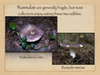
It is estimated that there are roughly 750 species of russula throughout the world. Most mycologists would agree that there are too many to know more than 30 to 50 comfortably. The majority, but not all, russulas are extremely fragile and may not stand up to cooking very well well. Some, though are meaty enough and sufficiently mild tasting that hunters collect them for the table - rather than kicking them out of the way! Some of the favorite russula edibles belong in the mariae group, the variata group or the green russula group. 025-001
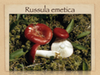
You can probably eat almost any russula without suffering more than a burnt tongue or mild upset stomach. An exception is Russula emetica. Eat this mushroom and you will vomit in technicolor! As described by Kibby and Fatto, there are approximately 128 russulas with red caps. 88 of these also have white stipes. Most mushrooms described as R. emetica are one of the many other look-a-likes. R. emetica is always in sphagnum moss. It is prudent not to eat any of the ‘bitterly hot’ red ones. 026-001
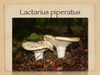
The ‘type’ species for the genus Lactarius, though recently it has been suggested that it is more closely related to species of russula than to other species of lactarius! First described by Linnaeus, the Swedish ‘Father of Taxonomy.' 028-001
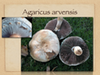
Worldwide there may be up to 300 species of Agaricus, some of which are edible, while others are poisonous. Our common button mushroom, Agaricus bisporus, is in this group. So is Agaricus campestris, the field mushroom. All agaricus have a fleshy cap, radiating gills, and a chocolatey brown spore-print. They also have a stipe and a partial veil which becomes a ring on the stalk. Agaricus arvensis is called the ‘horse mushroom.’ It has a sweet smell, cog-wheeled ring. The caps will often bruise yellow if rubbed, and the flesh will sometimes turn yellowish on exposure to air--but the flesh in the base of the stem is not yellow, which helps distinguish it from other species. 030-001
The cap center has brownish scaling. Yellowish to brownish droplets develop on underside of the annulus. Persistent ring. Bruises yellow at base. Saprobic. Yellow KOH reaction. Phenolic or no odor. The only known deadly agaricus grows in Africa, Agaricus aurantioviolaceus. 031-001
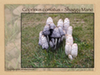
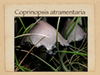
Saprobic. Found along roadsides, grass, disturbed ground. Cultivated in China. Coprine, which has unpleasant consequences if consumed with alcohol, is found in Coprinopsis atramentaria, but not Coprinus comatus. Coprinus comatus has also been found to kill two different nematode species! Coprinus comatus is more closely related to Agaricus and Lepiota than it is to the other dark-spored, ink producing, deliquesing mushrooms like Coprinopsis atramentaria and Coprinellus micaeus! 032-001
Inky cap. Mushroom that has close, furrowed gills which blacken and liquefy or deliquesce. Its liquid was once used as a black ink. It is a common mushroom that grows in clusters on wood stumps and buried wood from spring through fall, especially after a good rain. The bell-shaped cap is gray-brown with a few scales over the center. As the cap expands, the margin splits and liquefies so that the spores basically drop to the ground around the mushroom perimeter. This is just another way of distributing spores. This mushroom can cause a toxic reaction when alcohol is consumed within 12-24 (or more) hours. The symptoms include face-reddening, vomiting, palpitations, an tingling of the extremities within 10 to 15minutes of eating the mushrooms. The severity of the reactions is proportional to the amount of alcohol drunk and the timing of eating the mushrooms. No one is known to have died from eating inky caps with alcohol. There were several studies conducted to see if a drug containing the active ingredient - coprine - could be used in treating alcoholism, but it was found to have mutagenic properties. A drug based on a similar compound (Antabuse) was created to treat alcoholism. 033-001
Long-lived and among the largest organisms in the world. Armillarias live on wood of live and decaying trees. There is an Armillaria ostoyae that is thousands of years old and takes up 3.4 square miles. At least 10 species in US under the name Armillaria mellea. Most species are saprobic, but a few are parasitic and cause ‘white rot.‘ The rhizomorphs of Armillaria are called ‘foxfire’ because they bioluminese in the dark. The can grow at the rate of about 3 metres annually. Most species are tolerated by most people, but some are sensitive to them - especially if the mushrooms are a bit over-the-hill. Those that grow on conifers seem to be less tolerated than those that grow on deciduous wood. 034-001
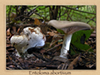
Entoloma abortivum. Contrary to expectations, the entoloma has transformed the honey mushroom. 035-001
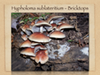
In clusters on decaying stumps and trunks of hardwoods. Gills are crowded and yellow. Autumn Mild to bitter Purple-brown s.p. Wickipedia says In Europe this mushroom is inedible, but it is eaten in the U.S. and Japan. It is apparently rarer than H. capnoides (edible) and H. fasiculare (inedible), though it is fairly common here in the fall. Bricktops. Rust-brown cap with pale edge, whitish gills becoming purple-brown. Definitely sabropic. It grows clustered on decaying hardwood. Taste can be mild to bitter. 036-001
Hypholoma fasiculare: Purple-brown s.p. On conifer & hardwood. Bitter Autumn Like the Brick-top, it is saprobic and is found clustered on wood and wood chips of hardwoods and conifers at the same time of year - fall after it has turned cold. It has yellow-green close gills, and a purple-brown spore-print. These have an extremely bitter taste and are known to be poisonous. Eating them will cause diarrhea, vomiting and convulsions. In Japan, several deaths are reported to be attributed to consumption of these mushrooms. 037-001
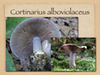
Blewits (blue hats) - Saprobic on leaf-litter and wood chips - white to pale pink s.p., whereas Cortinarius has rusty-brown s.p. Likes cold weather. Dries well. Delicious. 038-001
Differences between this and Clitocybe nuda: Cortinarius alboviolaceus has a dry cap, bulbous base, rusty brown s.p., but won’t see this till mushroom matures sufficiently. In early stages, might see a cortina or evidence of one on stipe. Also resembles Laccaria purpurea, which has a white s.p. There are several purple corts that can easily be confused with the blewit and each other. Eating any cort is not recommended as we haven’t studied all of them for edibility. Most that we have studied contain a toxin called orellanine, which damages the kidneys after a latent period of between 2 and 14 days after being consumed. 15% of cases of orellanine poisoning from eating corts have been fatal, which is a good reason for making a s.p. 039-001
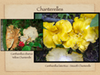
The main distinguishing feature of chanterelles is that they have gill ridges or folds as opposed to fleshy gills. Our chanterelle in the east is different from the western chanterelle, which is much bigger. Our most common chanterelle is not C. cibarius, but C. lateritius. What we call Catharellus cibarius may be several species. 040-001
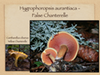
It has a soft velvety cap and stem (chanterelles have a smooth, firm cap). Thin flesh (unlike chanterelle). Has repeatedly forked, close, true gills (not blunt ridges like the chanterelle). Found on the ground under conifers, often near rotting wood in summer and fall. Saprobic. Considered edible by some authors and poisonous by others. It is known to cause hallucinations in some people. Genetically this mushroom is related to the boletus! 041-001
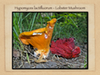
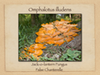
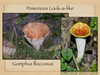
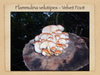
Contains muscarine which can cause severe gastric upset and sweating. Jack-o-lantern - formerly Omphalotus olearis then Omphalotis illudens (deceiving) - Clitocybe illudens Phylogentic study suggests its distantly related to O. Olearis, a different look-a-like. 042-001
Main differences between this and the true chanterelles is that this is hollow down the center and has a scaly cap. Both have a ribbed hymenium. Gomphus is larger. Another Gomphus - G. kaufmanii is more brown than orange to orange-red in color. 043-001
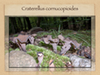
Called C. fallax in the east, they are genetically the same as C. cornucopioides, despite having a pinkish or yellowish spore print and different size-spores. They have been considered mycorrhizal because of their outdated taxonomic association with chanterelles, but are now thought to be sabrobic, though they may have an association with moss, where they are often found. They grow under both hardwoods and conifers. 044-001
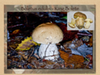
All boletes are mycorrhizal. They usually have a bun-shaped cap. Beneath the cap are pores. Lining the inside of the pores are the spore producing structures. Several boletes are considered choice edibles. Several will not be well-tolerated by your digestive system. Unless you are immune compromised, it is unlikely that any will kill you, although Boletus Huronensis will make you quite ill. The classic edible bolete is Boletus edulis. Boletus edulis is mainly a European and western U.S. mushroom that primarily grows under pines. There are several bolete species that are frequently misnamed Boletus edulis, but nearly all are equally delicious just the same. In the east, most of what we call B. edulis is either Boletus nobilis, B. pinophilus and B. variipes or some other species. They grow under oak. All exhibit some white reticulation on the stem and have roughly the same bun shape cap and swollen base, though the cap color may be pale tan rather than a rich reddish brown. 045-001
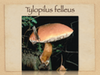
Looks good to eat and is often confused by beginners for Boletus edulis, but this species is extremely bitter. The difference between the two is that Boletus edulis types have a white reticulation and Tylopilus felleus has brown reticulation and like other members of the Tylopilus group - pinkish pores. 046-001
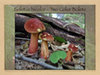
Boletus bicolor is a red and yellow medium to large bolete. The yellow pore layer is very shallow. The apex of the stem is yellow while the base is colored like the cap. There may be a few different varieties of Boletus bicolor. I’ve heard it said that Boletus bicolor doesn’t stain blue, but the yellow pore surface can stain bright blue. The flesh, however, is slower to stain and when it does it is a comparatively pale blue color. The two-colored bolete appears mainly in summer and is a prized edible. Not everyone can tolerate eating them though and these people may experience stomach upset and diarrhea. It is mycorrhizal with oaks and other hardwoods. 047-001
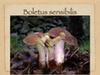
Boletus sensibilis is fairly common and looks and smells as if it is delicious. However, some people cannot eat this mushroom others can. I tried it myself last year and found it smelled curry-like, but was otherwise tasteless. The couple who cooked it up for us had been eating it for years without any problems. I had no bad reaction, nor did the other people who ate it. We didn’t eat much though, observing the caution to taste just a small amount one’s first time. I should point out that it is on record that one family got muscarine poisoning from eating B. sensibilis, characterized by constricted pupils, nausea, vomiting and exhaustion. (Michael Beug). It took several days for them to recover. 048-001
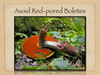
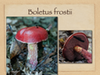
Red-pored Boletes and Boletus subvelutipes: The cap of this mushroom is often red and as such can be confused by beginners with Boletus bicolor - if you don’t notice that the pores are supposed to be yellow rather than red. There are red-pored boletes that are edible - such as Boletus frostii. And I have heard of mycologists who have eaten the black to dark indigo staining Boletus subvelutipes without any problem, but most books discourage you from eating red-pored boletes like this one. There may be several species that look very similar to B. subvelutipes in the east like Boletus discolor. This species has a fine hairy red tomentum at its base. 049-001
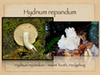
The main feature of the tooth fungi are the spines below the cap. The spores are produced there. The majority of tooth fungi are too tough to be edible. The Hydnaceae are now placed within the Order Cantharellales. Like the chanterelles, they are firm mushrooms. They are mycorrhizal with conifers and with hardwoods. White s.p. Hydnum repandum is larger than a similar edible species, Hydnum umbilicatum. 051-001
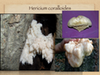
Hericium coralloides is sometimes also called Hericium ramosum. It is saprobic and possibly somewhat parasitic. Typically found on fallen logs or branches of hardwoods. Hericium erinaceus consists of a single unbranched body. Hericium americanum is more branched than Hericium erinaceus and grows from the woods of living trees and dead hardwoods. The spines are 1 cm of longer, whereas the spines of Hericium coralloides are 1 cm or less. Hericiums are rarely found on conifers. They are now placed in the Russulales. 052-001
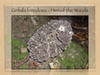
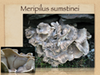
Grifola frondosa, or Hen of the Woods, is a choice soft-fleshed polypore. The Japanese call it Maitake. It is Saprobic and s.w. parastic. Hen of the Woods grows often in clusters on particularly oak tree bases. It causes a white butt-rot. Like the oyster mushroom, it can be and is cultivated. It can be confused with two other mushrooms, Meriplilus sumstinei and Polyporus umbellatus. All three are edible. 053-001
Both Grifola frondosa and Meripilus sumsteinei grow at the base of trees and cause a white rot. Likely weakly parasitic as well as sabropic. The types of wood destroying fungi encountered by pest management professionals and homeowners fall into two basic categories: brown rot and white rot. White rot attacks the cellulose and lignin in the wood giving the wood an off-white appearance. In the later stages the wood becomes spongy to the touch. White rot typically attacks hardwoods and lacks the cubical checking appearance of brown-rotted wood. Brown rot commonly attacks softwoods turning the wood dark brown. In advanced stages of decay, wood attacked by brown rot becomes friable and splits appear across the grain giving the wood a "checkerboard" appearance. Infested wood may be structurally weakened in a relatively short period of time. Once brown rot has extracted all of the nutrients from the wood the wood may become dry and powdery. This leaves the impression that dry wood has rotted (dry rot) but in reality it is an old infestation of brown rot. G. frondosa, they can appear year after year in the same location. This polypore, however, has larger lobed caps and smaller pores than Grifola frondosa. It stains black on handling. Though often confused with Grifola frondosa, both are choice edibles. Meripilus giganteus is a European species. 054-001
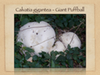
There is nothing that can be confused with Calvatia gigantea, expect perhaps a soccer ball. Usually found in fields, meadows and deciduous woods. Grow up to 3 or more feet wide within a week. Produces up to 9 trillion spores! Sometimes see them growing in fairy rings. Eaten with butter or olive oil and fried in Panko crumbs like eggplant. It’s sometimes used to make noodleless lasagna. 055-001
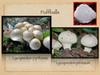
The puffballs are members of the artificial group called the gasteromycetes, or stomach fungi. Their spores are contained inside and are released through a tiny hole in the top by means of rain, wind, animals or insects. Other gasteromycetes include the false puffballs (Scleroderma and Pisolithus), stalked puffballs, bird’s nest fungi, earthstars, and stinkhorns. Except perhaps Calostoma, a stalked puffball, none are mycorrhizal. Lyco in Greek means ‘wolf’ Perdon means ‘ to break wind’ therefore a common name is Wolf’s fart. Pyriforme means ‘pear-shaped’ Lycoperdon perlatum grows on the ground, the other on decaying wood. Both are edible when white inside. They shouldn’t be confused with Scleroderma citrina or a death angel button. You also want to be cautious about breathing in large amounts of spores. Several years ago students from Wisconsin were told the spores were hallucinogenic. They inhaled so many that they germinated in their lungs and grew Hyphae. They were given anti-fungal drugs and their respiration returned to normal. 056-001
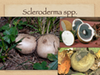
Scleroderma citrina is packaged in Europe and sold as a substitute for truffles. A small amount eaten raw has been reported to cause muscles to lock up, temporary vision problems and deep sleep. 057-001
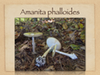
Amanita phalloides is commonly called the Death Cap. It is natively a European mushroom which was introduced to the US by at least the 1970‘s with its associated trees. It is now in many continents including Australia, parts of Africa and South America. The caps are greenish-yellow. Gills and veil are white with hints of yellow-green. It smells faintly sweet to cloyingly sickly sweet. The majority of fatalities due to mushroom poisoning are a result of consumption of this mushroom. It apparently looks similar to straw mushrooms and out west is confused with them. One has to eat only half a cap to be threatened with an agonising death. It is believed that Emperor Claudius and the Holy Roman Emperor Charles the 6th were deliberately poisoned by the Death Cap. Its toxic ingredient damages the liver and kidneys - usually fatally. One of the only known antidotes is a milk thistle compound. 058-001
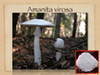
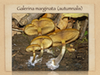
Puffballs are undifferentiated inside. Amanitas show the whole mushroom. Deadly ‘Destroying Angel,’ is the most poisonous of our native eastern Amanitas and accounts for 90% of the deaths by wild mushrooms. It contains cyclopeptides that destroy the liver. There are two equally poisonous and virtually indistinguishable amanitas, Amanita verna and Amanita bisporigera. It is found June through October under hardwoods. The toxin is a protein by the name of alpha amanitin, a cyclopedtide which works by slowly attacking an enzyme in the liver. Both the liver and the kidneys are ultimately affected about 6 to 24 hours after consumption. Symptoms include violent cramps and diarrhea. There is a false remission of symptoms by the third day. On the 4th and 5th day the liver and kidneys continue to break down. Death follows unless a liver transplant can be performed. The same toxin is in the Autumn Galerina. 059-001