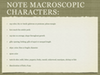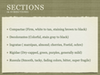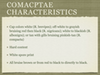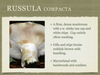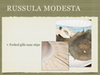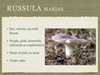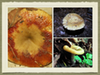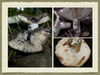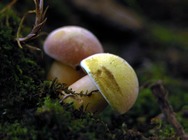
Click on the first slide to see an enlarged version and to progress through the presentation.
In the RUSSULALES there are not only the many gilled Russula and Lacyarius species, but there are also crusts, toothed fungi, stereums, hypogeous fungi, coral fungi and polypores. Most are mycorrhizal, but some are sabrobes or parasites. (Heterobasidium annosum is a conifer pathogen). All of these have in common with russulas and lactarius - amyloid spores - turn blue in Meltzer’s reagent, which is mostly iodine. 002-001
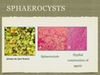
The sphaerocysts explain why russulas and lactarius are so fragile a break like a piece of chalk. (The Compacte group are exceptions) Photo on left from Ton Volk’s Fungus of the Month for June 2000. 004-001
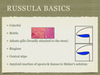
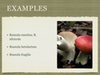
We see more russulas than any other kind of mushroom, yet are least able to identify them to species. Mycologists avoid them, too, because so many look like each other. Unfortunately, it is necessary to use detailed diagnostic features to determine the species of most russulas - including use of the microscope and chemicals. 006-001
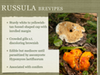
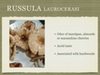
Inedible. Odor becomes fishy and unpleasant as the mushroom matures. White s.p. Very common east of Rockies. 011-001
Short foot. Often has debris in cap. Can be easily confused with Lactarius deceptivus & Lactarius piperatus, which lactate and L. piperatus has a longer stem. 012-001
Sometimes also called R. nigricans, a European mushroom which may or may not be here. Takes about a half-hour to turn from red to black. 013-001
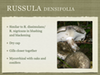
No waxy feel to cap - more felty. Turns from white to brownish.Unlike R. dissimulans, the cap peels about half-way. Russula adusta is similar-looking to R. densifolia, but more brownish. Found under pines. 014-001
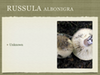
This is not R. Albonigra, though like it - it bruises black without going through a red stage. Albonigra is seen more on west coast than east. It is a large mushroom with decurrent gills. 015-001
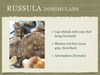
Copper orange cap - cuticle doesn’t easily peel Gills frequently forked by stem. Light Yellow spore print Like the (reddening then) blackening white russulas, it’s flesh is firm. The graying or blackening is not immediate. 019-001
Egg-yoke yellow cap, leaving a depression in center of mature FB Slightly sticky, leaving debris on cap Fruity odor Caps peels half-way Can be confused with R. ochroleuca, which doesn’t gray and grows mainly with conifers. 020-001
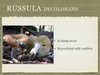
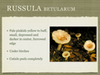
It may take up to an hour for a scrape to turn black. Cuticle peels half-way. Pale yellow spore print. 021-001
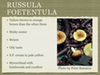
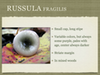
Easily confused with R. fragrantissima, which may or may not be a separate species. Sticky, depression, deeply striate margin. 025-001
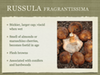
RUSSULA fragrantissima. 026-001 Click on the first slide to see an enlarged version and to progress through the presentation.
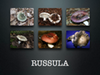
Used to be called R. virescens, a European mushroom . The virescens-crustosa group includes at least 12 different species in eastern N.A. Until they all are named, we will continue to call some of them virescens. Also confused with R. aeruginea, which is sticky in center. 031-001
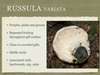
Russula cyanoxantha (European name) is very similar in green and purple colors, but has less conspicuous forking (only at stipe, if at all; and has a mild taste, grows with both hardwoods and conifers. Both R. variata and R. cyanoxantha have a white spore print. 033-001
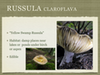
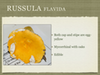
Russula claroflava grays. It is sticky. R. flavida is dry and velvety. Cuticle peels half-way. Gills are white becoming cream to yellowish. 035-001
Gills white bcmg cream Spore print cream to pale yellow Edible. Cuticle peels more than half-way. 036-001
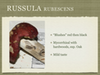
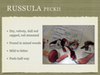
Can be confused with R. sanguinea (European name) - found under conifers and is more common to west coast than east coast. Russula peckii is not edible. 037-001
Extremely bitter. Odor mildly fruity. Cuticle peels 3/4 of way. Appears in late summer and autumn. 042-001